New in Version 4 — Universal File Converter

Complex Routing:
One Pass, Every Destination

Real-world data doesn't live in one place — and the systems that consume it were never designed to agree with each other. Complex Routing eliminates the multi-step workaround entirely.

View Plans & Pricing
Your order management system speaks SQL Server. Your regional warehouse feed runs on MySQL. Your compliance and audit trail lives in PostgreSQL. Historically, getting one source file into all three meant writing three separate conversions, running them one after another, and hoping the source data didn't change shape in between.

Complex Routing eliminates that entirely — one source file, one pass, every destination populated correctly, automatically.

How It Works

One Field. One Pass. Every Destination.

At the center of Complex Routing is a single routing field — any column in your source data that meaningfully distinguishes one record from another. It might be a region code, an order type, a claim category, a carrier ID, or a status flag.

1

Choose your routing field

Tell Universal File Converter which field to watch — region code, claim type, order status, carrier ID, or any column that separates one record from another.

2

Define match rules per destination

Set which values route where. Each rule maps a field value — or a range, a pattern, or a catch-all — to a specific SQL destination, target table, and field mapping.

3

Configure each destination independently

Every destination gets its own SQL connection, its own dialect (SQL Server, MySQL, or PostgreSQL — mixed freely), its own target table, and its own field mapping. A field named CUST_ID can land as customer_id in one destination and CustomerID in another.

4

Run once — everything lands where it belongs

Every record in your file is evaluated against those rules exactly once, and sent immediately to the right place. No intermediate staging files, no multi-step batch jobs, no reruns.

A Concrete Example

One Order File. Four Destinations.

Say you run a distribution business with a single daily order export — one flat file, one format, thousands of records — but three regional fulfillment databases and a shared exceptions table for anything that doesn't fit a known region.

Routing configuration — by region code

  • East Orders coded East route to a SQL Server table at your East Coast fulfillment center — with the column layout and field mapping that system expects.
  • West Orders coded West route to a MySQL database at your West Coast warehouse — different server, different schema, different SQL dialect.
  • Central Orders coded Central route to a second MySQL instance for central distribution — its own connection, its own table.
  • Catch-All Anything that doesn't match a known region code — a typo, a new market, a data entry error — falls through to a PostgreSQL catch-all table, so nothing silently disappears and your team has a clean list to review.

With Complex Routing, this is one configuration, run once. The router reads each order record, checks the region field, and writes it straight into the correct destination table with the correct column layout — East Coast orders never touch the West Coast schema, and the catch-all table quietly accumulates anything unexpected instead of failing the whole run or getting lost.

Built for People, Not Just Pipelines

No Code. No Scripts. Point and Click.

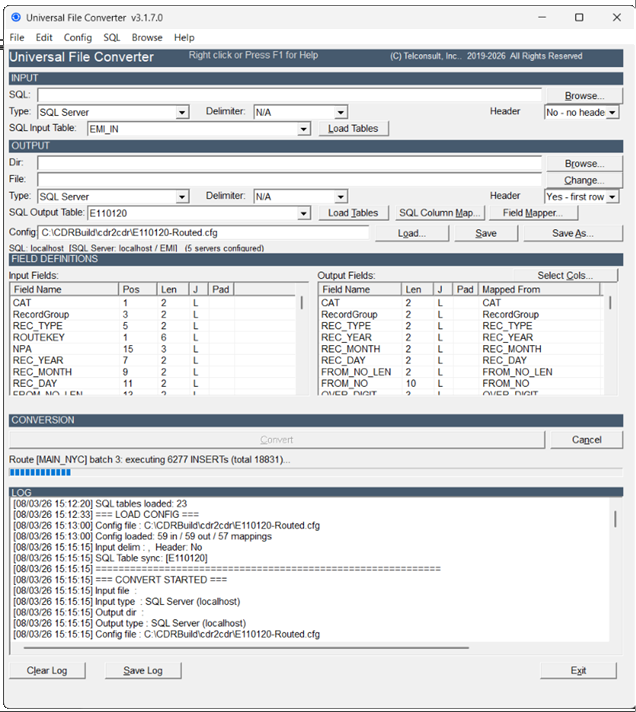
Universal File Converter — Complex Routing in action, multiple SQL Server destinations
🖱️

Visual, point-and-click configuration

Select your routing field, add match rules for each destination with a few clicks, browse to each connection and field mapping. No text file, no script, no database procedure.

👥

Non-technical staff can maintain it

New regions, new categories, new destinations — business users can adjust routing rules as needs change without touching code or calling in a developer.

➕

Add destinations in minutes

Because every destination's configuration is saved independently, adding a fourth region, a new SQL dialect, or an additional exceptions table is a matter of minutes — not a re-engineering project.

🗄️

SQL Server, MySQL, and PostgreSQL — mixed freely

Each destination in the same routing set can use a different SQL engine. Route to all three in a single pass, with each destination getting the dialect and schema it expects.

Read Once. Route Intelligently. Deliver Everywhere.

Complex Routing turns a job that used to require multiple tools, multiple runs, and constant manual reconciliation into a single, repeatable, auditable process.

View Plans & Pricing →

Questions? Email [email protected]